



How TEDA's Nucleic Acid Industry Makes an Advancement
Recently, the 10th China (Tianjin) Nucleic Acid Therapeutics Conference was held in TEDA, gathering over 1,000 representatives from renowned national research institutes, universities, and upstream and downstream enterprises across the nucleic acid drug industrial chain for in-depth exchanges in the nucleic acid field. Why did this premier industry gathering choose TEDA? In the fiercely competitive new track of nucleic acids, how has TEDA carved out a distinctive development path?

Leading Enterprises Spearhead Full-Chain Development of Nucleic Acid Drugs
In 1998, Asymchem took root in TEDA. Grown from TEDA into a leading global CDMO enterprise, the company has strategically deployed active pharmaceutical ingredient (API) CDMO and high-end preparation production lines in the nucleic acid field. For over two decades, almost every expansion of Asymchem has synchronized with the industrial pulse of this land, serving as an important driving force in propelling TEDA's biopharmaceutical industry forward.
Similarly, CanSino Biologics, which also grew up in TEDA, is an innovative vaccine enterprise listed on both the A-share and H-share markets. Recently, alongside continuous investment in its mRNA vaccine platform, the company initiated clinical trials in Indonesia for its independently developed inhaled tuberculosis booster vaccine, and reached an intention of cooperation on the 13-valent pneumococcal conjugate vaccine (PCV13) with its Pakistani partner AGP Limited, achieving comprehensive enhancements in technology, production capacity, and global footprint.
A strategic move by leading enterprises revitalizes the entire industry. Leveraging the siphon effect of industry leaders, upstream and downstream nucleic acid drug enterprises have converged rapidly in TEDA. To date, TEDA has forged a full-chain nucleic acid pharmaceutical industrial chain encompassing key links such as nucleic acid raw materials and APIs, nucleic acid vaccines, synthesis equipment, purification devices and packing materials, nucleic acid drug delivery carriers, nucleic acid formulations, and related technical services. With more than 40 supporting enterprises, a nucleic acid drug industrial base—the largest in northern China—has taken clear shape.
Alliance Synergy Clears Bottlenecks in Industrial Collaboration
As enterprises grow and expand, their collaborative demand for raw materials, equipment, consumables, R&D services, process scale-up, and achievement transformation continues to intensify, making it difficult to achieve efficient integration by operating in isolation. Against this backdrop, the Tianjin (TEDA) Nucleic Acid Industry Alliance was officially established in 2023. Jointly formed by relevant enterprises, public institutions, and organizations in TEDA's nucleic acid sector, the Alliance is committed to building a world-leading specialized industrial park and cluster covering the entire industrial chain, including nucleic acid drugs, mRNA vaccines, and instruments and equipment. The Alliance has set up dedicated information, project, intellectual property, service, and resource platforms for nucleic acid drugs, establishing institutionalized connections among enterprises and institutions to facilitate segmented breakthroughs, complementary capabilities, risk sharing, and revenue sharing, thereby pooling cluster strength to tackle the bottlenecks of new drug R&D.
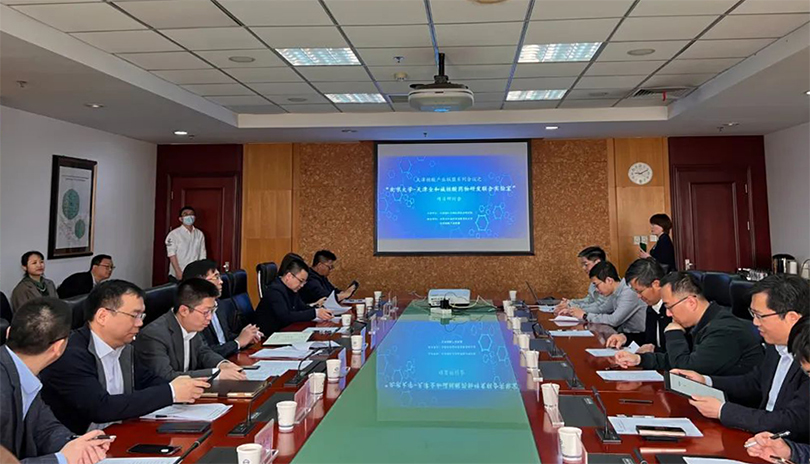
Following its establishment, the Alliance grew rapidly and now boasts 62 member entities covering the entire chain of "industry, academia, research, and application". With the continuous deepening of synergistic effects across the Alliance, cooperation among members has transitioned from information exchange to tangible project implementation: CanSino and JenKem Technology reached strategic cooperation in mRNA vaccines; CanSino joined hands with Cosychem in delivery technologies; Cosychem partnered with Academician Chen Runsheng's team to build an academician collaborative innovation center; and the municipal key laboratory for non-clinical evaluation of biopharmaceuticals undertaken by Yugen Medtech successfully passed acceptance, gaining official certification for its CGT R&D service capabilities.
"The core to truly retaining enterprises and strengthening industries lies in building a mature and complete industrial symbiotic system", which has become a shared consensus driving the development of TEDA's nucleic acid industry.
Turning the Blueprint into Reality: TEDA Nucleic Acid Pharmaceutical Industrial Park Established
The implementation of an industrial symbiotic system requires spatial carrier support. In January 2025, TEDA issued the Implementation Plan for the Construction of the TEDA Nucleic Acid Pharmaceutical Industrial Park, designing an overall layout of "one-core development and multi-point synergy" and outlining a clear "roadmap" for industrial growth. Centering on key links in the nucleic acid drug industrial chain, the Implementation Plan focuses on the "1+5" core industrial directions. Specifically, "1" refers to utilizing next-generation nucleic acid technologies to actively forge a new growth engine for biomanufacturing; "5" represents five sub-sectors: nucleic acid innovative drugs, nucleic acid vaccines (mRNA vaccines), pharmaceutical R&D outsourcing services, nucleic acid medical devices and delivery carriers, and high-end pharmaceutical equipment and consumables, aimed at building an intact industrial chain. Relying on existing leading enterprises or premier institutions, each sub-sector advances industrial chain layouts around critical technological milestones, maps out the nucleic acid pharmaceutical industry landscape, clarifies industry development orientations, and provides deep cultivation and comprehensive support for core enterprises.

In September 2025, the TEDA Nucleic Acid Pharmaceutical Industrial Park was officially inaugurated. Located in the West Zone of TEDA, the industrial park covers approximately 2.3 million square meters. Its built-up area already hosts enterprises and institutions such as CanSino Biologics, JenKem Technology, Bonna-Agela, and Tianjin Vocational College of Bioengineering; its start-up area gathers Asymchem projects, the Azemidite nucleic acid monomer project, and the Faerma nucleic acid API and preparation integration project; while the eastern expansion area accommodates projects such as Biosepur and Cosychem Biotech. The Tianjin Nucleic Acid Industry Innovation Service Center was also inaugurated concurrently. Built upon the Tianjin (TEDA) Nucleic Acid Industry Alliance as a specialized institution integrating full-chain management, operation, and technical services for nucleic acid pharmaceuticals, the center comprehensively focuses on the core demands of the industrial park to continuously propel the upgrading of the regional nucleic acid pharmaceutical industry.
Over the past year, development within the industrial park has visibly accelerated: Asymchem prioritized high-end preparation production lines for nucleic acid API CDMO; CanSino Biologics carried out the development of preventive and therapeutic nucleic acid vaccines; Phase I of Faerma's integrated small nucleic acid raw material and preparation project was completed and commenced trial production; Azemidite, established by Ribo Life Science—hailed as "China's first small nucleic acid stock"—matured its nucleic acid monomer production capacity, achieving stable commercial supply; JenKem Technology focused on nucleic acid drug delivery systems; and Cosychem established joint experimental platforms for nucleic acid technologies with leading universities including Peking University, Nankai University, and Tsinghua University.
What Drives This Confidence?
The flourishing development of TEDA's nucleic acid industry is by no means accidental; it follows a distinct industrial logic. As a major industrial city in northern China, Tianjin possesses deep accumulation in the chemical sector, providing robust raw material guarantees and process engineering support for the nucleic acid industry. Universities and research institutes, such as Nankai University, Tianjin University, Tianjin Medical University, and the Tianjin Institute of Industrial Biotechnology, Chinese Academy of Sciences, constitute a multi-tiered talent support system. Furthermore, Tianjin's strengths in computing power and data create abundant possibilities for artificial intelligence to empower nucleic acid drug R&D.

The overall strength of TEDA's biopharmaceutical industry forms the bedrock for the development of its nucleic acid drug sector. In 2025, the industrial output value of TEDA's biopharmaceutical sector reached RMB 55.45 billion, accounting for more than half of Tianjin's total, thereby providing solid support across supply chains, talent pools, and innovation ecosystems for this specialized nucleic acid pharmaceutical track.In 2025, Phenomenex, a global innovator in chromatography, established its China R&D Center in TEDA, largely attracted by the region's complete biopharmaceutical industrial chain. "TEDA has brought together a substantial number of pharmaceutical and biotechnology enterprises, exhibiting prominent synergistic effects across upstream and downstream segments from R&D and production to quality inspection," said a relevant official of the company. "As a provider of analytical technologies and solutions, we can closely collaborate with regional clients, enabling rapid feedback of customer needs to the R&D front and immediate validation and iteration of new products and methods within real-world application scenarios."
In terms of intellectual property and financial support, the China (Binhai New Area) Intellectual Property Protection Center offers services such as fast-track patent pre-examination for biopharmaceutical enterprises. In 2024, the TEDA Market Supervision Administration (Intellectual Property Office), jointly with the Patent Examination Cooperation (Tianjin) Center of the Patent Office, CNIPA, released the Patent Navigation Report on the Nucleic Acid Drug Industry—Tianjin's first patent navigation report in this sector—providing critical guidance and decision-making support for industry, academia, research, and application. In February this year, the TEDA Daoyuan Life Sciences Fund, the first specialized biopharmaceutical sub-fund under the TEDA Guidance Fund, was officially established with an initial scale of RMB 100 million, focusing on frontier tracks such as innovative drugs, high-end medical devices, and digital healthcare to inject vital financial liquidity into industrial innovation.
At the end of 2025, the TEDA Future Industry Cultivation and Development Action Plan (2025-2027) was officially promulgated and implemented, explicitly outlining the construction of a "4+2+X" future industrial development system. Among them, nucleic acid pharmaceuticals were identified as one of the four cornerstone tracks, setting the development target of "building a nationally leading innovation highland for the nucleic acid pharmaceutical industry", and sending a clear signal of seizing the commanding heights in this sector. Moving forward, TEDA will fully leverage the dual platforms of the Nucleic Acid Industry Alliance and the TEDA Nucleic Acid Innovation Service Center to coordinate and integrate industrial, capital, and scientific research resources, concentrating efforts on developing specialized parks covering the entire nucleic acid pharmaceutical value chain, and striving to build a national benchmark for the high-quality development of the nucleic acid pharmaceutical industry.


 津公网安备 12019002000128号